


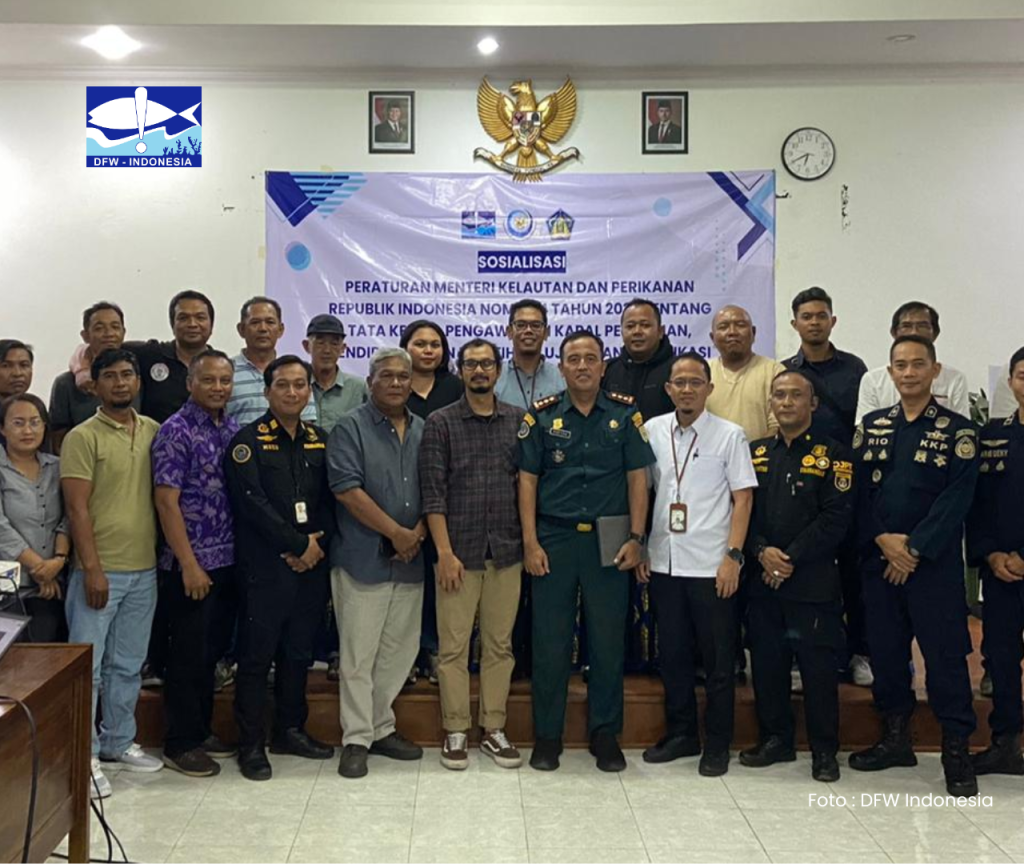
Denpasar, 10 March 2026 – On 7 November 2025, the Ministry of Marine Affairs and Fisheries (KKP) issued the Ministerial Regulation of Marine Affairs and Fisheries (Permen KP) Number 4 of 2026 concerning the Governance of Fishing Vessel Crewing, Education and Training, Examinations, and Certification of Fishing Vessel Crew (AKP). Permen KP Number 4 of 2026 is a regulation that revokes Chapter 5 and Annexes XXIX and XXXVIII in Permen KP Number 33 of 2021. Therefore, Destructive Fishing Watch (DFW) Indonesia, in collaboration with the Nusantara Fishing Port (PPN) Pengambengan, carried out a socialization activity of Permen KP Number 4 of 2026 at the hall of the Indonesian Seafarers and Fisheries Workers Union (KP3I) in Benoa, Bali. This socialization aims to increase a uniform understanding among business actors in Benoa, as well as to build a constructive dialogue between regulators and business actors so that the implementation runs effectively and sustainably.
According to Kartono, Head of PPN Pengambengan, the socialization of Permen KP Number 4 of 2026 is considered important because currently among business actors there are still multiple interpretations regarding this new regulation. This confusion has the potential to lead to non-compliance in the future by business actors.
“With the implementation of this socialization, it is hoped that there will be clarity for all stakeholders in Benoa, to jointly commit to implementing the regulation. In the future, it is expected that there will no longer be debates regarding the substance of the Regulation [Permen KP Number 4 of 2026] because all the ambiguities in the Regulation will be explained in detail in this activity. Thus, going forward, this regulation will become a guideline in the protection of workers that must be complied with by companies, vessel owners, and workers, especially fishing vessel crew,” he said.
Permen KP Number 4 of 2026 is a strategic regulation issued by the government to strengthen the national fishing vessel crewing system. This aspect includes the education, training, examinations, and certification of fishing vessel crew (AKP). This regulatory revision was made to ensure navigation safety, workforce professionalism, and the protection of workers’ rights. As a major capture fisheries hub, Benoa is also a vulnerable area for AKP. Based on data collected by DFW Indonesia through the National Fishers Center (NFC) Indonesia, until early 2026 many AKP in Bali still reported cases related to unpaid wages or wage deductions, insurance and social security, as well as the withholding of their documents/identities.
In his presentation, Mijil, Head of the Fishing Vessel Crewing Working Team at the Directorate General of Capture Fisheries, emphasized that Permen KP Number 4 of 2026 is a regulation that was revised to complement international norms. This regulation has incorporated the substance contained in the rules of the ILO Convention 188 (ILO C-188) as well as the Standards of Training, Certification and Watchkeeping for Fishing Vessel Personnel (STCW-F).
“The inclusion of the substance of international regulations, in this case the rules of ILO C-188 and STCW-F, shows that the government, particularly the Ministry of Marine Affairs and Fisheries, is very concerned about the protection of vessel crew according to international standards. Thus, although Indonesia has not yet ratified C-188, this regulation becomes a starting point in efforts to provide more comprehensive protection for fisheries workers,” said Mijil.
Imam Trihatmadja, Program Director of DFW Indonesia, conveyed that there are several changes in the pillars of the Regulation’s substance that focus on human resources (HR) on fishing vessels. With these changes, it will certainly affect business actors and fishing vessel crew workers themselves.
“We found that there are much more detailed additions, strengthening of workers’/crew rights, standardization of education, and updates to the wage system in Permen KP 4/2026 compared to Permen KP 33/2021. Hopefully, with the existence of this regulation, the level of incidents of problems experienced by vessel crew can be minimized and there will no longer be victims among vessel crew who are harmed due to loopholes in regulations exploited by unscrupulous labor actors,” Imam concluded.


