


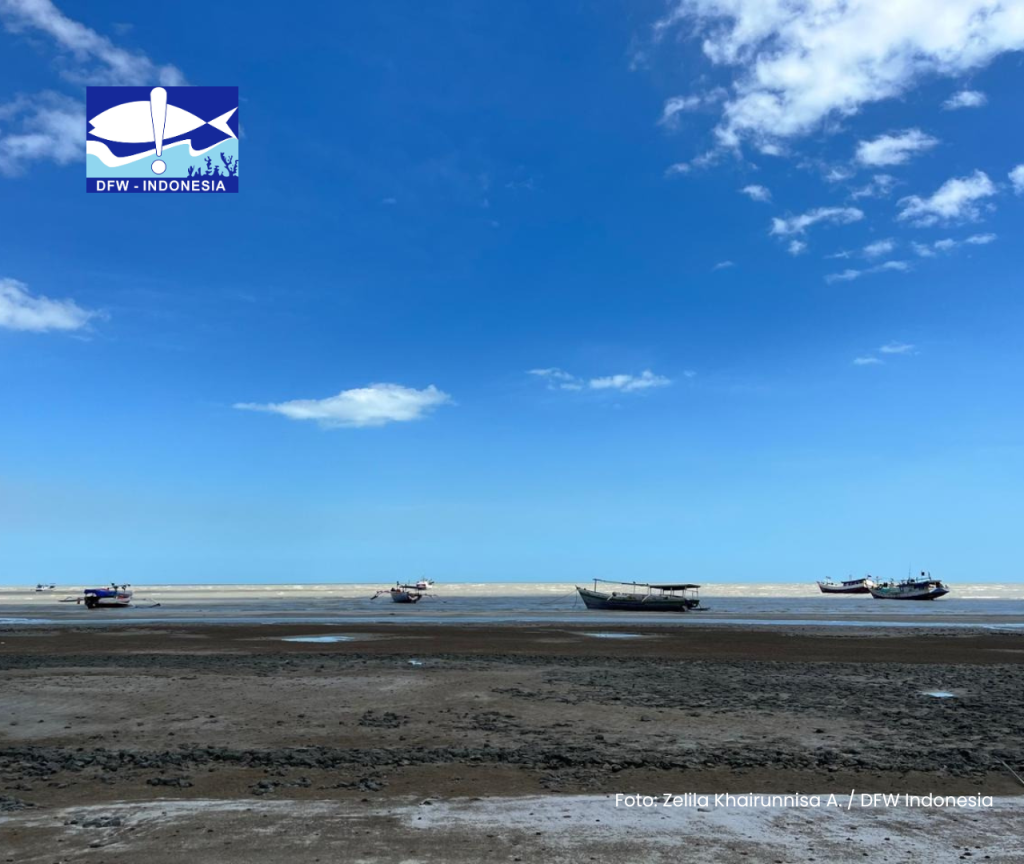
Writer: Zelila Khairunnisa A., DFW Indonesia Researcher
Along the coast of Merauke, fishers and their wives continue to recount one troubling reality: Indonesia’s seas are no longer able to provide enough to support their families. Over the past two to three years, fish catches in Indonesian waters have steadily declined. Concerns over dwindling fish stocks have been further intensified by the arrival of Shrimp Trawl Net (known as Jaring Hela Udang Berkantong/JHUB) vessels operating in Fisheries Management Area (Wilayah Pengelolaan Perikanan or WPP) 718. This situation has driven larger fishing vessels to cross international maritime boundaries into the waters of Papua New Guinea (PNG).
Semang-semang fishers and fishing vessel crew members (Awak Kapal Perikanan/AKP) in Binaloka Village on the coast of Merauke explained that two nights at sea now yield catches that are not even enough to cover the initial costs of a fishing trip. Meanwhile, in Kumbe Village, one fisher’s wife complained that trawling operations can sweep up everything on the seabed, including coral reefs and juvenile fish. These conditions ultimately sparked fishers’ protests in Merauke in April 2026. On the other hand, the local government argued that the demonstrations were primarily driven by concerns among local fishers over shrinking access to fishing grounds and the declining availability of high-value fish species.
Amid declining catches, fish maw (hipio) —the gas-filled swim bladder found in fish, particularly Chinese Seabass and Gulama—has emerged as a commodity that has dramatically reshaped fishers’ economic calculations. Fish maw can sell for millions of rupiah for just a few dozen grams, far exceeding the market value of the fish itself. This lucrative trade has encouraged larger fishing vessels, starting from 27 gross tons (GT), employing fishing vessel crew members, to target fish primarily for their swim bladders. It has also pushed them to seek fishing grounds farther from Indonesian waters, including across the maritime border into PNG.
The most common reason cited for engaging in such risky cross-border fishing activities is the greater abundance of fish in PNG waters compared with Indonesian waters, largely due to the relatively small number of local fishers operating there. The decision to fish across the international boundary is also driven by soaring fuel prices, complicated bureaucratic procedures for obtaining subsidized diesel fuel, and the high cost of basic necessities in Merauke. Juwita (a pseudonym), the wife of Santo (also a pseudonym), an AKP who regularly crosses into PNG waters from Binaloka Village, explained that fishing in Indonesian waters makes it difficult to earn even ten million rupiah, whereas fishing in PNG waters consistently produces much higher returns despite the considerable risks. Several local fishers also stated that those who successfully return from cross-border fishing trips can earn hundreds of millions of rupiah from a single trip.
Santo works as a crew member aboard a fishing vessel owned by a businessman from South Sulawesi. He admitted that he has crossed into PNG waters twice since 2025. Each fishing trip lasts approximately 20 days, after which he does not return to sea for around five months. The journey to PNG can take three days and three nights through strong currents, and vessels crossing into foreign waters typically switch off their lights to avoid detection. Juwita described how she constantly monitored the radio while her husband was at sea, anxiously waiting for news during his cross-border trips. Santo himself recalled breaking down in tears after believing he was being pursued by a PNG patrol vessel, only to discover that it was merely a commercial cargo ship.
The dangers faced by fishers crossing illegally into PNG waters are far from hypothetical, and the penalties are severe. Under PNG law, foreign fishing vessels caught operating illegally may be sunk or burned, while all crew members can face imprisonment for up to ten years or even life imprisonment. Additional threats come from pirate groups operating in PNG waters. According to several fishermen, pirates frequently rob vessels of their catches. They also recalled an incident in which a fishing crew member attempting to flee after entering PNG waters was shot dead, and his body was never returned to his family.
To reduce the number of vessels engaging in cross-border fishing, policymakers and relevant stakeholders should consider several measures. These include strengthening transparent public outreach regarding the JHUB policy, enhancing fisheries monitoring and surveillance, and improving cross-border cooperation and diplomatic engagement with PNG. Such measures are essential because the phenomenon of cross-border fishing in Merauke is the cumulative result of economic hardship, unequal access to marine resources, inadequate fisheries enforcement, and weak social protection for fishing vessel crew members and small-scale fishers amid the expansion of large-scale industrial fishing operations such as JHUB. Unless these underlying structural issues are addressed, the risks and threats associated with crossing international maritime boundaries are likely to remain a reality for many fishers who see few viable alternatives under increasingly difficult conditions in Indonesian waters.


