


Indonesia’s fisheries industry, particularly the tuna commodity, plays a strategic role in the national economy and global trade. Over the past five years, fishery product exports have shown a steady upward trend, rising from USD 4.56 billion (2021) to USD 6.27 billion (2025), an average annual growth of around 8.3%, driven by international market demand and Indonesia’s position as one of the world’s leading tuna producers. Benoa, Bali, is the second-largest center for landing, processing, distribution, and export of captured fisheries after Muara Baru, Jakarta. This activity contributes to state revenue, regional economic growth, and large-scale employment absorption in the fish-catching and processing sectors.
As a hub of the fisheries industry, Benoa attracts fishery workers from various regions across Indonesia, such as East Java, Central Java, West Nusa Tenggara, East Nusa Tenggara, Maluku, and North Sulawesi. This reflects the fisheries industry’s heavy reliance on local labor. Amid growing global attention to the social and labor dimensions of fisheries sustainability, the industry must meet ecological standards and product quality requirements while also ensuring the protection of workers’ rights, safety, and welfare throughout the supply chain.
Fish processing workers, particularly those in tuna freezing, still face a range of challenges, such as limited access to standardized training, uneven implementation of Occupational Health and Safety (OSH) principles, and insufficient understanding of labor rights and protection mechanisms. One pressing issue that needs to be addressed is that tuna processing workers do not yet hold tuna processing certification. This is despite the existence of relevant regulations, such as Manpower Ministerial Decree No. 78 of 2016 on the Establishment of the National Work Competency Standards (SKKNI) for the Food Processing Industry Category in the Field of Tuna Fish Freezing (Kepmenaker 78/2016), and Regulation of the Minister of Marine Affairs and Fisheries of the Republic of Indonesia No. 2 of 2019 on the Implementation of the Indonesian National Qualification Framework (KKNI) in the Field of Tuna Fish Processing (Permen KKP 2/2019). Kepmenaker 78/2016 sets out the competency standards for tuna fish freezing, including the minimum knowledge, skills, and work attitudes that tuna freezing workers must possess, and applies nationally. Meanwhile, Permen KP 2/2019 was established to ensure the competency, standardization, and qualification of the workforce in Indonesia’s tuna processing industry. However, implementation remains limited and has not yet become mandatory for workers and business operators, resulting in a gap between workforce competency and product quality. In fact, as of late 2024, the Level 1 Operator (entry-level worker) occupational certification scheme, which had been proposed by the Marine Affairs and Fisheries Professional Certification Body (LSP KP), had still not been issued by the National Professional Certification Agency (BNSP). At the same time, business operators have also faced various difficulties, including the challenge of recruiting workers with the appropriate competencies, establishing career paths and wage standards for workers, and declining tuna quality.
On that basis, Destructive Fishing Watch (DFW) Indonesia, in cooperation with the Center for Marine and Fisheries Training (Puslat KP) of the Ministry of Marine Affairs and Fisheries, carried out a collaborative initiative to build the capacity and certification of workers at tuna Fish Processing Units (UPI), in support of sustainable marine and fisheries management, by pushing for the issuance of a tuna freezing certification scheme. The scope of this cooperation includes conducting a training needs assessment (IKD); developing curricula and training modules; raising awareness of the urgency of competency among tuna processing workers; and building the capacity and competency of tuna processing workers through training, competency testing, and certification.
Implementation of this cooperation has proceeded through activities aligned with the joint work plan set out in the cooperation agreement. The first activity was an initial dissemination session on Permen KP No. 2 of 2019, addressing the urgency of tuna processing certification—particularly for tuna freezing—for tuna companies belonging to the Indonesian Tuna Longline Association (ATLI). The second activity was the training needs assessment (IKD), carried out through visits to PT Hatindo Makmur and PT Sari Segar Laut in Benoa, Bali, using questionnaires and interviews with 4–5 Level 1 tuna freezing operators as well as company management at each site. The results of the IKD were used to develop a curriculum and training modules, producing five teaching materials: Sanitation and Hygiene in Frozen Tuna Production; Occupational Health and Safety (K3) in Tuna Freezing Operations; Handling Raw Tuna Materials; Production Processes in Tuna Freezing; and Packaging of Frozen Tuna Products.
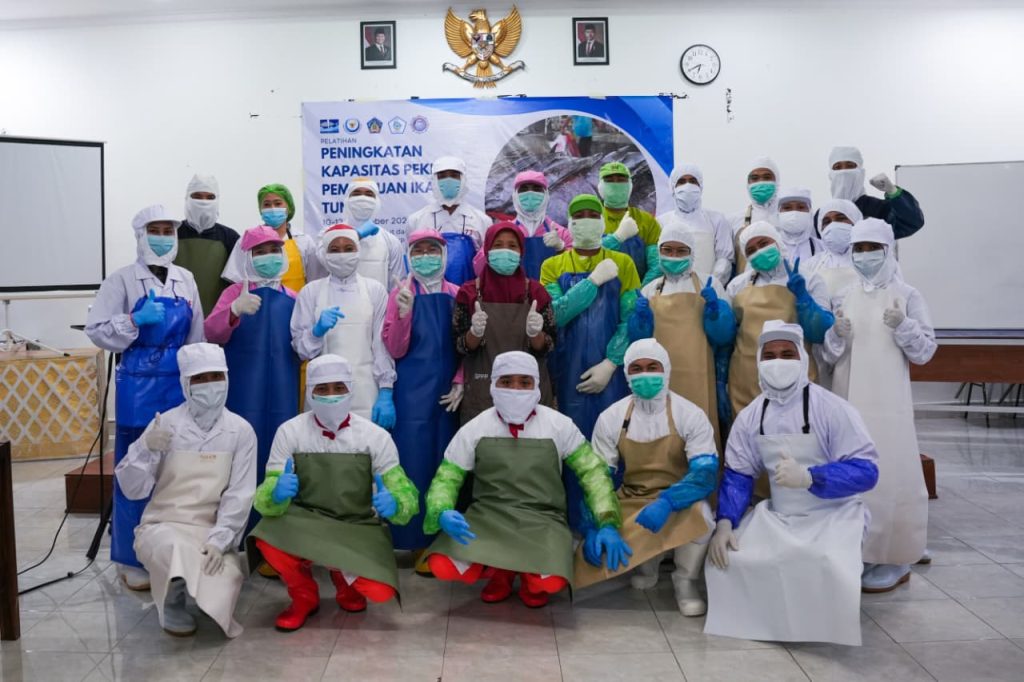
DFW Indonesia, together with Puslat KP and BPPP Banyuwangi, held a Capacity Building Training for Tuna Freezing Workers in December 2025. This activity also served as a trial run for the newly developed modules and teaching materials. The training was attended by 27 participants from 13 tuna processing companies in Benoa, Bali, including former fish processing workers. Participants came from PT Satu Enam Delapan, PT Indotama Bahari, PT Bali Mina Utama, PT Bandar Nelayan, PT Sari Segar Laut Indonesia, PT Perintis Jaya Internasional, PT Hatindo Makmur, PT Bintang Jayakota Mandiri, PT Bali Nusa Windumas, PT Iambeu, PT Intimas Surya, PT Perikanan Indonesia (Benoa Branch), and PT Primo Indo Ikan. In terms of gender composition, participants consisted of 18 men and 9 women, reflecting the important role of women workers in the tuna freezing industry. Participants’ educational backgrounds varied, ranging from junior high school to university graduates, with the majority having a senior high school/vocational school (SMA/SMK) background, consistent with the workforce profile of this sector. Participants from mid-to-large companies brought differing work experiences, production practices, and working conditions. During discussion sessions, participants shared experiences related to work standards, challenges in implementing sanitation and hygiene procedures, the use of personal protective equipment (PPE), and managing workloads under extreme temperatures. This interaction strengthened the learning process, as the material presented was not merely theoretical but was directly connected to the everyday work realities faced by participants.
The training also played an important role in improving participants’ understanding of workers’ rights and labor protection mechanisms. Through an introductory session on the National Fishers Center Indonesia (NFC-I), participants received information on basic worker rights, indicators of forced labor and labor violations, and the complaint, referral, and support service mechanisms available to fishery workers. This introduction was highly relevant to participants, given that most of them work under short-term contract arrangements that leave them vulnerable to labor rights violations. Participant enthusiasm was clearly evident, particularly when discussing safe and confidential complaint channels. Participants expressed strong interest in learning how NFC-I services could be accessed—whether by phone, website, or in-person visit. Through this session, participants not only gained information but were also encouraged to build collective awareness of the importance of sharing information and supporting fellow workers in addressing labor-related issues. As such, this training contributed not only to individual capacity building but also to strengthening social networks and solidarity among tuna processing workers in Benoa.
As a result of this training, participants received training certificates from BPPSDM KP, which will later serve as one of the requirements for taking the tuna freezing competency test. Separately, since April 2025, there has been a change in the organizational structure of the Marine and Fisheries Human Resources Extension and Development Agency (BPPSDM KP), under the mandate of Regulation of the Minister of Marine Affairs and Fisheries No. 2 of 2025 on the Organization and Working Procedures of the Ministry of Marine Affairs and Fisheries, which added the Center for Standardization and Certification of Marine and Fisheries Human Resources (Pusat SS SDM KP). Pusat SS SDM KP is mandated to carry out the standardization and competency certification of the marine and fisheries workforce. As a result, supervision of the submission of the tuna freezing worker certification scheme by LSP BPPP Banyuwangi to the National Professional Certification Agency (BNSP) was transferred from Puslat KP to Pusat SS SDM KP.
Meanwhile, as of mid-June 2026, the certification scheme submitted by LSP Banyuwangi had still not been issued by BNSP, even as the time gap between the training and the competency test grew considerably longer. This risked reducing the number of participants ultimately able to take part in the certification process, as some had already resigned from their companies.
In late June 2026, the Tuna Freezing Operator Occupational Certification Scheme from LSP KP was finally issued by the National Professional Certification Agency (BNSP), allowing the scheme to be used for the Competency Test. Of the 13 companies and 27 total participants from the earlier training, only 25 participants were able to take part in the Competency Test held in August 2026; the remaining participants opted not to proceed with the testing stage.
The Competency Test material under the scheme consists of eight competency units: 1) Implementing Occupational Health and Safety (K3) in the workplace; 2) Receiving fresh tuna raw material; 3) Washing raw material; 4) Performing temporary storage (chilling); 5) Performing butchering; 6) Storing products in the chilling room; 7) Performing freezing; and 8) Performing packaging. The competency test was conducted using written tests, question-and-answer sessions, and practical assessment, divided into two methods: direct observation of practice in the processing area, or observation of simulations and practice videos accompanied by Observation Support Questions (PMO). As a result of this Competency Test, all participants were declared competent by the Assessors.
With the issuance of this tuna fish freezing occupational certificate, workers now receive formal recognition of their competency and expertise. Entry-level workers involved in fish freezing production are, in fact, skilled and capable workers essential to producing quality products. This benefits not only the workers themselves but also the companies and the market. It is therefore important to foster shared awareness among all stakeholders of the importance of workforce capacity building in order to create added value and strengthen the competitiveness of Indonesian fishery products in international markets.


